


The aim of this section is to provide help and support for Interpreters when they are faced with a potential distressing clinical situation.
According to the World Health Organisation, mental health ‘is a state of wellbeing in which the individual realises his or her own abilities, can cope with the normal stresses of life, can work productively and fruitfully and is able to make a contribution to his or her own community’.
The way you are feeling and how you cope with everyday life is your mental state. As this is always changing, it is extremely important to recognise the emotional, behavioural and physical signs of stress that could lead to a breakdown of our mental state. The summary table below has been created using the information from Mind as a summary for the different signs of stress.
| Emotional | Behavioural | Physical |
|
|
|
|
|
|
|
|
|
|
|
|
|
|
|
|
|
|
|
|
|
|
|
|
|
|
|
|
|
|
|
|
|
|
||
|
||
|
Created using information from Mind
As well as in your everyday life, during interpreting you may have had to deal with stressful and challenging appointments such as emergencies or breaking bad news. If you have noticed any of the signs above, it is important to know how to address this.
In some situations, stress cannot be prevented. However there are good ways to manage it better. Here are some things you can try:
- Share your problems and speak to a family member, friend, or approach your GP
- Dedicate some time for your hobbies and interests
- Take some time-out from your everyday routine for a break or a holiday
- Exercise and eat healthily
- Ensure that you get enough quality sleep
The NHS have a great section on how to tackle stress. This includes:
- 10 Simple Stress Busters
- Time management techniques
- Mindfulness
- Breathing exercises
- Helpful apps to download
- Audios
This is a legislation in England and Wales that covers the assessment, treatment, and the rights of people with a mental health disorder.
- As an interpreter, it is your responsibility to treat everyone as equal and with respect, regardless of their age, gender, disability, sexual orientation, religious or political beliefs.
- You need to be aware of your own safety and wellbeing in any given environment.
- If you need to report any safety issues, you should ensure that you inform the relevant professional as soon as possible.
Interpreting within a mental health setting can be extremely challenging.
- To help you prepare for the assignment, ensure you arrive early to assignment and ask the professional to brief you about the session.
- You will also need to establish any ground rules in relation to the patient such as communication strategies.
- Seating arrangements should also be decided in advance. You should ensure that you have a clear exit from where you sit.
- Ensure you are never left alone with the service user.
- At the end of the assignment, ensure that the service user and the professional have tied things up and ask whether any further appointments need to be arranged.
Other challenges you may face include:
- Trouble listening due to noisy environment. In these situations, try your best to focus. Do not be afraid to ask the service user or professional to repeat what they said. However, try to keep this to a minimum as it will affect the flow of the session.
- Difficulties understanding patients’ expressions/ any speech impediments. Ensure you inform the professional that you are having difficulties understanding the patient. They know it can be challenging but try to interpret as best as you can.
- Personal beliefs/ experiences making it difficult to interpret. You must remain impartial at all times.
- Being overwhelmed due to the nature of the assignment. If you are unable to continue due to the nature of the assignment, inform the professional straight away and let them know that you are unable to do any further interpreting.
- De-brief with the professional to bring the appointment to an end.
- If you need support of any kind, find someone to speak to without breaking the confidentiality of the assignment. For example, you could speak to someone in the Linguist Relations Department or to Quality Control co-ordinators.
- Good night’s sleep
- Physical activity
- Mindfulness
- Talking and connecting with other people
- Having some ‘me time’
- Maintaining a positive outlook
- Making time for your hobbies
Samaritans
Telephone: 116 123 (24 hours a day)
Email: jo@samaritans.org
Website: www.samaritans.org
Mind
Telephone: 0300 123 3393 (9 am -6pm Monday to Friday)
Email: info@mind.org.uk
Website: http://www.mind.org.uk
Saneline
Telephone: 0300 304 7000 (4:30pm-10:30pm)
Website: http://www.sane.org.uk/what_we_do/support/helpline
Rethink Mental Illness
Telephone: 0300 500 0927 (10 am -2 pm Monday to Friday)
Email: info@rethink.org
Website: https://www.rethink.org/
Young Minds
Telephone: 0207 089 5050
Email: ymenqueries@youngminds.org.uk
Website: https://youngminds.org.uk/
- Call 999
- Go to your nearest Accident and Emergency department (A&E)
- Book an appointment with your GP
- Call NHS direct on 111
It is sometimes inevitable due to human nature to become involved in what others around us are feeling or going through.
This is especially difficult for interpreters as they have to interpret in the first person and convey the feelings and emotions of the non-English speaker as if they were their own. The publications below will give you further information on dealing with work-related stress:
Translation Journal’s article Emotional and Psychological Effects on Interpreters in Public Services:
https://translationjournal.net/journal/33ips.htm
The International Journal of Translation and Interpreting Research: The impact of emotional and psychological factors on public service interpreters:
http://www.trans-int.org/index.php/transint/article/viewFile/386/218
Research paper by Ingrid Kurz at the University of Vienna: PHYSIOLOGICAL STRESS DURING SIMULTANEOUS INTERPRETING: A COMPARISON OF EXPERTS AND NOVICES:
https://core.ac.uk/download/pdf/41171608.pdf
Research paper by Mailee Lor at St. Catherine University: Effects of Client Trauma on Interpreters: An Exploratory Study of Vicarious Trauma:
https://sophia.stkate.edu/cgi/viewcontent.cgi?article=1053&context=msw_papers
https://www.nhs.uk/conditions/stress-anxiety-depression/understanding-stress/#symptoms-of-stress
https://www.nhs.uk/conditions/stress-anxiety-depression/understanding-stress/#how-to-tackle-stress
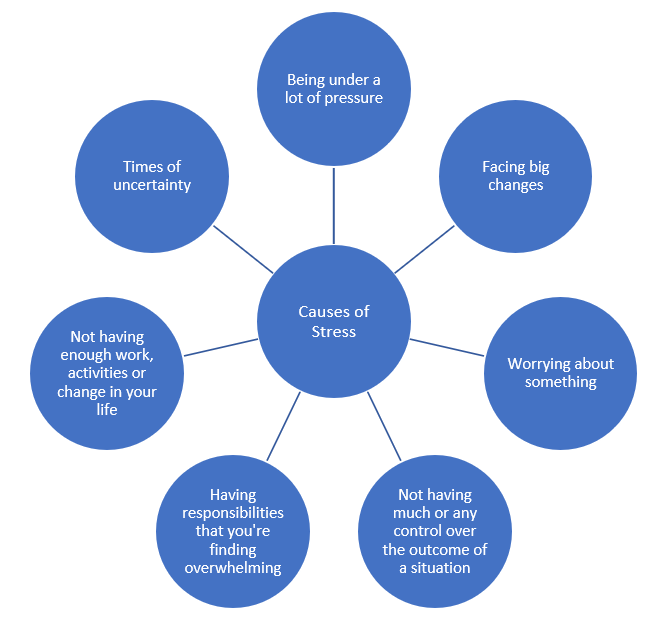
Causes of stress/ image created https://www.mind.org.uk/information-support/types-of-mental-health-problems/stress/causes-of-stress/#.XQd-krxKiUk
Mental health disorder https://www.nhs.uk/using-the-nhs/nhs-services/mental-health-services/mental-health-act/
